On this page
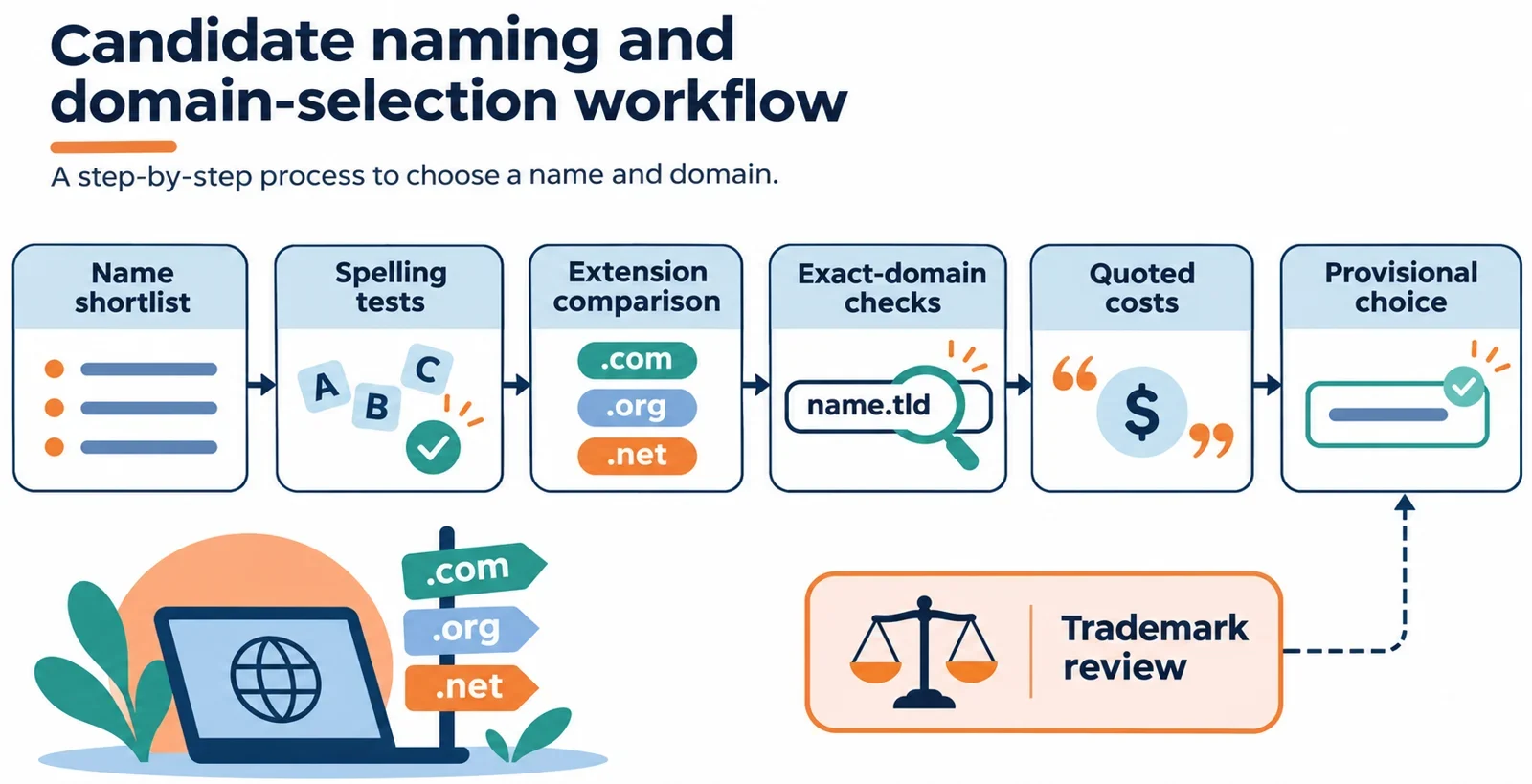
Compare generated brand names by testing the complete domain strings, assessing how well each extension fits your audience, and comparing quoted costs over the same period. Keep domain availability and trademark review as separate checks. A name that looks appealing in a generator still needs to work when someone hears it, types it and associates it with your business.
Start with a small shortlist and use the same worksheet for every candidate. Record unclear answers as open questions, then choose a provisional favorite and a backup. If every domain option introduces awkward spelling, weakens the identity or exceeds your budget, return to the name itself.
Build a shortlist from demonstrated generator inputs
Begin with a keyword that describes the intended brand, then collect a manageable batch of suggestions. Use the generator’s visible controls as your starting point. If it offers style or length settings, record the labels you selected; if those options are absent, leave them out of your comparison.
For each candidate, save the keyword, any selected settings, the generated name and the domain string you want to investigate. Keep the displayed name separate from the version without spaces. This makes it easier to see whether a promising name becomes awkward when written as a domain.
Change one input at a time when generating another batch. For example, keep the keyword while changing an available style setting, then compare the results against the same brand description. Choose a few candidates with distinct strengths rather than filling the list with near duplicates.
Treat every suggestion as a candidate for further checks. Its appearance in a results list should not settle either domain availability or trademark questions.
Test spelling and readability
Say each candidate aloud and ask someone to write it without seeing the spelling. Avoid giving hints during the first attempt. Compare what they write with your intended name, then repeat the exercise with the complete proposed domain, including its extension.
Pay particular attention to silent letters, doubled consonants and letter choices that allow more than one plausible spelling. Record the actual mistake instead of simply marking a candidate as difficult. A repeated missing letter gives you a clearer editing decision than a vague impression.
Next, read the domain without spaces. Look for unclear word boundaries, adjacent repeated letters, omitted vowels or an unintended reading. Ask another person to read the string aloud before explaining where the words divide.
Keep separate notes for spoken spelling and visual readability. A candidate may pass one test while causing trouble in the other. Before retaining a troublesome option, decide whether a small revision solves the problem without changing the intended identity. If the revised spelling still needs an explanation during each test, put a clearer candidate ahead of it.
Compare extensions and confusing variants
Evaluate each extension against the audience and market you intend to serve. Ask what your readers would expect to type and whether the complete address fits the brand you want them to recognize. Keep any eligibility or registration requirements pending until you confirm them for that extension.
Build a short variant list for each serious candidate:
- Likely misspellings revealed by your listening test.
- Singular and plural versions, where relevant.
- Alternative divisions between words.
- Other extensions you are considering for the same name.
Investigate whether similar domains could send someone toward another business. Record the specific overlap: similar spelling, a related name or an audience you also want to reach. Give unresolved similarities a visible place in the worksheet rather than burying them in general notes.
Use the same questions for every extension. Would you feel comfortable saying the full address aloud? Would customers need repeated reminders about its ending? Would the extension still make sense if your intended audience changed? These questions help compare fit without assuming that one extension suits every brand.
Check each exact domain separately
Look up every complete domain you are considering, including its extension. Give each exact string its own worksheet row so the result for one option cannot accidentally become the result for another.
Record the lookup service, the result wording and the observation date and time. If the service displays an offer, save its details alongside the lookup result. Keep your own interpretation in a separate note so you can distinguish what the service reported from what you still need to establish.
A reported absence of a registration record does not establish a purchasable offer. Where the result leaves reserved status, premium treatment or purchase eligibility unclear, ask the relevant provider to confirm the exact domain and applicable terms. Do not guess at the meaning of an unfamiliar status label.
Use an explicit unresolved status whenever you cannot connect the lookup result to a clear offer. Continue comparing spelling and brand fit while that question remains open, but keep the candidate provisional. Recheck the exact domain when you are ready to make the decision.
Compare registration and renewal terms
Create a cost worksheet for each exact domain and registrar combination. Compare quotes over the same ownership period, with the same assumptions about how long you intend to keep the address.
| Worksheet field | What to record |
|---|---|
| Exact domain and registrar | The complete string and provider quoting it |
| Initial term | The period covered by the registration quote |
| Registration charge | The quoted amount and currency |
| Renewal term and charge | The quoted renewal period and amount |
| Mandatory charges | Any required additions disclosed in the offer |
| Premium treatment | Whether special registration or renewal terms are disclosed |
| Open questions | Anything the provider has not clarified |
Keep missing figures marked unknown. Historical examples or another domain’s quote should not fill those cells.
If your comparison covers the initial term plus one renewal, add the applicable quoted charges and disclosed mandatory extras for that period. Check that the term lengths actually match across candidates. Avoid treating an introductory charge as though it also applies at renewal.
Set a budget before choosing a favorite. If a promising domain has unclear renewal terms, retain it as provisional until you can compare its costs with the alternatives on the same basis.
Decide whether a domain compromise preserves the brand
Compare three approaches where relevant: the exact brand name with your preferred extension, the same name with another suitable extension, and the name with a relevant word added. Assess each complete address through the same spelling, readability, audience and cost checks.
For a word addition, ask whether it helps someone understand or remember the brand. Try introducing the business aloud and then giving the address. Listen for a mismatch between the name you say and the words someone must type. Test the revised domain without first explaining your reasoning.
For an alternative extension, repeat the full spoken test and resolve any applicable requirements. Keep the choice tied to the audience and identity you intend to serve.
Write down your rejection thresholds before comparing favorites. You might reject an option that repeatedly produces the wrong spelling, needs an unwanted identity change or exceeds your planned ownership budget. Apply those thresholds consistently. If every compromise fails them, generate another batch of names using what you learned. A different candidate may deserve consideration before you commit to an address that remains difficult to explain.
Choose a provisional winner and resolve outstanding checks
Keep a preferred domain and a backup, each with a short written explanation. Include the strongest spelling result, the reason its extension fits, the quoted costs and any unresolved questions. This makes the decision easier to review without relying on how appealing the name felt during generation.
Before committing, work through the remaining checks:
- Recheck the exact domain and the offer you intend to accept.
- Confirm registration and renewal terms, currency and mandatory charges.
- Resolve applicable extension requirements and unclear status labels.
- Review confusing variants that could affect the choice.
- Address trademark and business-name questions separately.
A trademark search is distinct from legal clearance. Keep its result separate from the domain lookup, and seek appropriate professional advice when legal questions remain.
If the preferred option no longer meets your criteria, assess the backup using the same worksheet. If both fail, return to generation with a more precise brief: preserve the qualities that tested well and change the features that caused confusion or unacceptable costs. Choose once the practical and financial checks support the same candidate.