In this guide
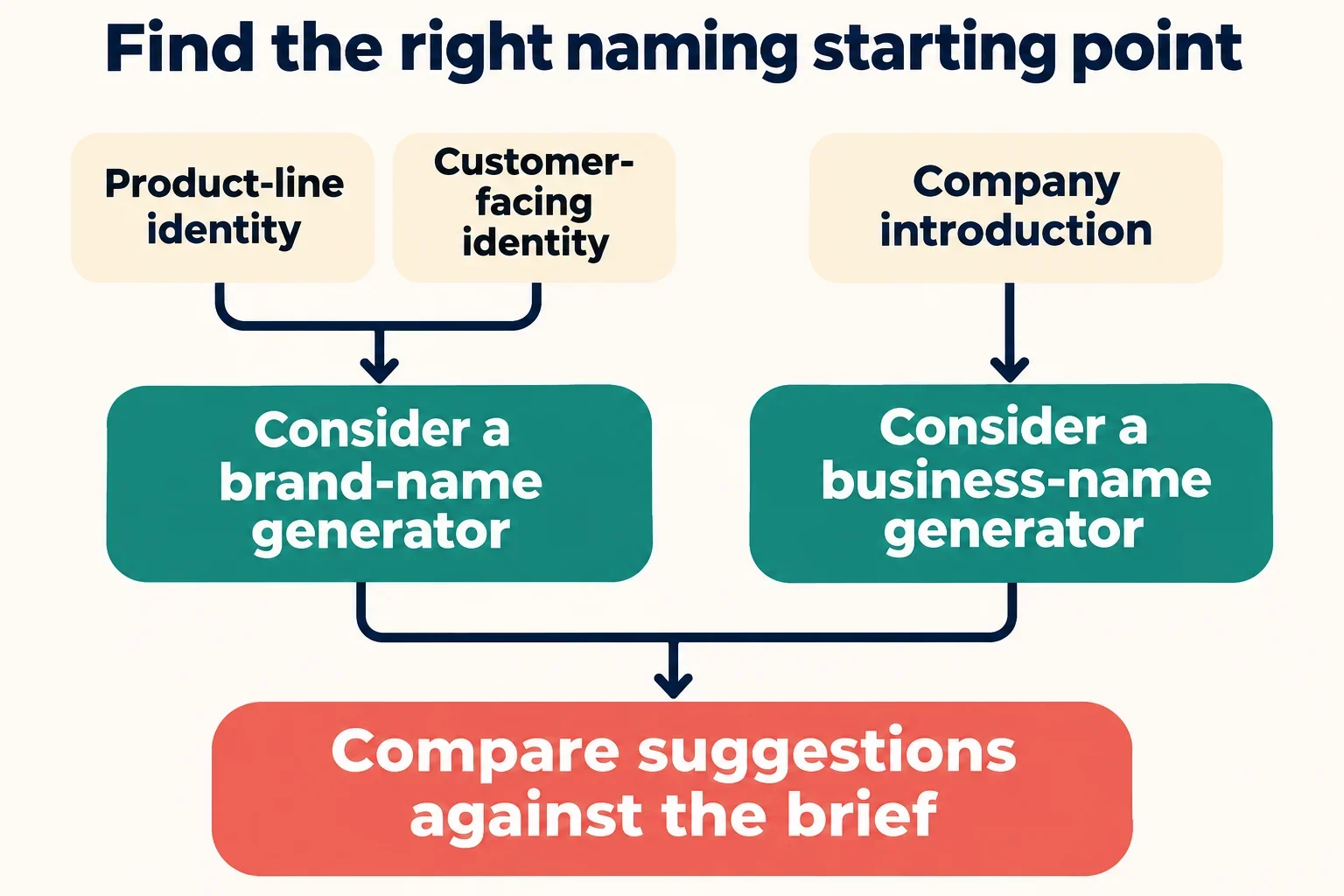
Start with a brand-name generator when your main task is exploring the identity of a product line or the impression a customer-facing name should create. Start with a business-name generator when you are naming a venture and want to test candidates in an introduction about what it offers. When one name needs to do both jobs, compare both starting points against the same brief.
The tool label is only a starting point. Look at the inputs actually available and judge the suggestions by their relevance to your needs. A useful result should make sense in the situations where you intend to use it. Build a shortlist through that practical comparison, then investigate registration, trademarks, domains and social handles separately.
Decide what the name needs to represent
Before entering a keyword, finish this sentence: “I need a name for ___.” Be specific about whether you mean a product line, the identity customers will encounter, the company, or several of these together. This gives you a clearer basis for judging suggestions than simply choosing whichever generator sounds closest to your project.
Next, describe where the name would appear. You might be imagining a product label, a customer introduction, a website heading or company paperwork. Treat these as intended uses to test, and identify which matters most. A candidate that sounds appealing beside a product description still needs a separate review if you also want it to represent the wider venture.
The terminology can overlap. UK guidance distinguishes a business’s legal name from a potentially different name used to market its products or services. Australian guidance describes a business name as the name a business trades under and tells customers. Those examples are a reason to check the terminology and requirements that apply where you operate, rather than assuming “business” always means something separate from the customer-facing identity.
Write a brief you can reuse
Record your offer, target customers, values and intended market position. Then add the impression you want the name to convey and the roles it must serve. Keep this brief beside you while comparing suggestions. If you change your mind about the audience or offer, revise the brief before judging another set of names.
When to start with a brand-name generator
A brand-name generator is a reasonable starting point when you are exploring a product-line identity or the voice a customer-facing name should support. Begin with the impression you want to investigate, then assess whether the available inputs let you express it. The label alone does not establish that a tool has specialized settings or produces a particular style of result.
One useful approach is to choose a word that captures a feeling, material or point of view. For a hypothetical project, that might mean exploring a feeling such as “calm,” a material relevant to the offer, or a point of view such as “curious.” These are possible directions for a brief, not promises about the suggestions a generator will return.
Choose the direction deliberately. If you use a material as your starting word, ask whether you actually want that association in the name. If you use a feeling, describe what it means for your intended customers. An attractive keyword is less useful when you cannot explain its connection to the offer.
Test the intended voice
Place a candidate in a short piece of proposed customer-facing wording: “Meet [name], our collection of ___.” Then try wording that expresses your intended tone. Ask whether the name feels coherent in both contexts and whether someone can connect it to the accompanying description.
Keep candidates that deserve further testing. You do not need to adopt the first appealing suggestion, and you can compare the same brief with a business-name generator if the name must also introduce the venture.
When to start with a business-name generator
A business-name generator is a reasonable starting point when the immediate task is introducing a venture. Focus your brief on what you offer and the impression you want that introduction to leave. A word drawn from the offer or intended impression gives you a concrete starting point for exploring candidates.
Begin by writing an ordinary explanation of the business without trying to make it sound like a name. For example: “We provide ___ for ___.” Identify the word that best represents either the offer or the way you want to present it. If the tool accepts a keyword, use that word and assess the resulting suggestions against your explanation.
Test each promising candidate in a complete sentence: “My business, [name], offers ___.” Read it aloud, then try a shorter introduction. Ask whether the name works naturally with the description and whether you would feel comfortable repeating it in conversation. A name does not have to explain every part of the offer, but you should be satisfied with how the introduction works as a whole.
Separate a useful suggestion from a registration decision
At this stage, you are judging naming fit. Put “works in an introduction” and “checked for intended use” in separate columns in your notes. Leave the second unresolved until you complete the relevant checks.
If the same candidate must also appear on products or carry your customer-facing identity, test those uses too. Starting with a business-name generator does not settle which roles the final name should serve.
Compare inputs and outputs using the same brief
Use the same naming brief to compare the two starting points. Where both tools accept a keyword, begin with the same word. Where comparable settings are available, keep them aligned. If one tool offers an input the other does not, record the difference rather than treating the two attempts as equivalent.
First review the visible controls. Use only the fields and settings actually offered; do not assume that either generator supports industry selection, tone controls, length preferences or availability checks. If the inputs differ substantially, you can still compare how useful the suggestions are for your task, while recognizing that you asked the tools different questions.
Apply a shared evaluation sheet
Review candidates against the brief before deciding which generator was more useful.
| Criterion | Practical test |
|---|---|
| Relevance | Explain how the candidate connects to your offer or intended impression. |
| Pronunciation | Read it aloud and ask another person how they would say it. |
| Spelling | Say it without showing it, then ask someone to write what they heard. |
| Sentence fit | Insert it into a sentence explaining what you offer. |
| Role fit | Try it in each intended use, including the product line or wider business where relevant. |
These exercises help you inspect a candidate; they are not a substitute for understanding your intended customers. If someone hesitates, ask what caused the hesitation and decide whether it matters for your use.
Change one condition at a time when you try again. For example, keep the brief fixed while changing the keyword from an offer word to an impression word. Record which names remain relevant and why. This makes the comparison easier to interpret than changing the audience, keyword and settings together.
Choose the starting point that gives you more candidates worth developing. Either label may lead to useful suggestions; your brief provides the standard for judging them.
Decide whether one name can serve both purposes
If you want one name for the customer-facing identity and the wider business, make that a requirement in your brief. Test each candidate in both roles before becoming attached to it. A name that works for a collection deserves another look when placed in an introduction covering everything the venture intends to offer.
Use a small set of realistic sentences:
- “We are [name], and we offer ___.”
- “Explore the [name] collection of ___.”
- “Contact [name] about ___.”
Fill the blanks with your actual plans. Notice where you need awkward wording or an explanation you would prefer to avoid. If a candidate fits one role especially well, consider whether you want it for that role alone or whether another candidate better meets the combined brief.
Test plausible expansion
Australian naming guidance recommends considering whether a proposed name is too specific to a product or place if the business later expands. Apply that question to changes you can realistically imagine. Would the name still fit if you added a related service, introduced another product line or operated in another location?
You do not need to plan every possible future venture. Write one or two plausible expansion sentences and test the shortlist against them. A specific name may still suit your priorities; the useful decision is whether you accept that specificity. Record your reasoning so you can distinguish a deliberate choice from an issue you overlooked.
Check the shortlist before committing
Once you have candidates that fit the brief, move from brainstorming to checking intended use. Keep a separate record for each name, including its exact spelling and any version you would consider adopting. A generated suggestion is not proof that you can register, protect or use it.
The following checks address separate questions. Investigate each one that applies to your plans rather than treating a favorable result in one area as an answer to all the others.
| Check | What to establish |
|---|---|
| Company or business-name register | Which register and naming requirements apply to your intended business structure and jurisdiction? |
| Trademarks | Which searches and official guidance apply to the name, your activities and the places where you intend to operate? |
| Domain | Can you obtain the exact web address you want under the applicable terms? |
| Social handles | Can you use the preferred spelling on each platform you intend to use, under its rules? |
Follow the relevant official guidance for your jurisdiction. For a US venture, the Small Business Administration’s launch guidance is an official starting point for broader launch planning. Use the appropriate local authorities elsewhere, and seek qualified advice when you need help interpreting requirements or search results.
If a check leaves a question unresolved, keep that status visible in your shortlist. If you change the spelling or add a word, assess the revised candidate on its own merits and repeat the checks that apply.
Choose your preferred name after reviewing both its practical fit and the relevant checks. Your final decision should explain why the name serves its intended roles, how it works in use, and what you have established before adopting it.