On this page
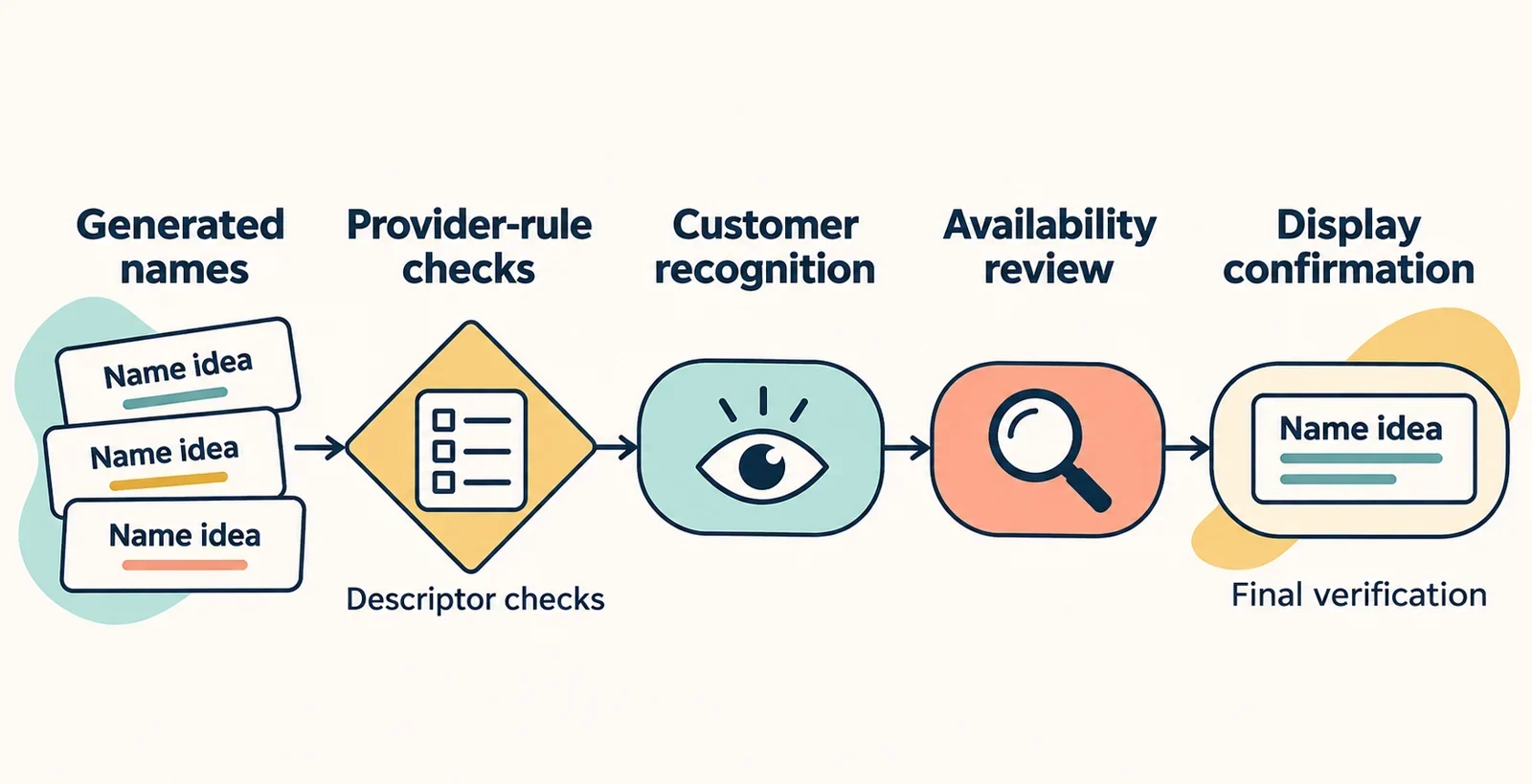
Choose a generated business name by checking two things together: the name customers encounter when buying and the statement wording your payment provider permits. A promising candidate should remain recognizable in whatever form you are allowed to configure.
Start with a small shortlist, record the applicable payment requirements, and compare each candidate with its proposed statement version. Then check recognition, name availability and the final display. Treat a generator result as a starting point for those decisions. A name that reads well on its own still needs to work within your payment setup, and a compliant proposal still needs confirmation before you rely on it.
Identify the name customers will recognize
Write down the proposed legal name, trading name, checkout wording and receipt wording for each candidate. For UK naming decisions, the legal name is the business’s official legal name; a trading name is used to market products or services and may differ from it.
Keep this exercise focused on what you intend customers to see. If checkout or receipt wording has not been decided, mark it as a proposal rather than assuming it will match the generated name.
Choose the recognition anchor
Underline the distinctive word or phrase you most want a customer to remember. Prefer a simple, clear, memorable trading name. Then ask whether that same wording can be carried through the buying experience and the proposed statement form.
For example, with the hypothetical name Willow Lantern Studio, you might choose Willow Lantern as the recognition anchor. That choice does not establish whether the shortened wording is permitted. It gives you something specific to protect when comparing alternatives.
Keep unresolved wording choices beside the candidate so they remain visible during later checks.
Generate a shortlist using confirmed controls
Open the business-name generator you intend to use and inspect its visible inputs before planning a search. Confirm whether it offers language, style, keyword, batch size, length range or seed controls. Use only the options actually present; if a setting is absent, handle that preference when reviewing results.
If a keyword input is available, try a word connected to your business or the impression you want the name to convey. Where other controls exist, adjust one at a time so you can compare the resulting candidates. Record the settings you used alongside names worth keeping.
Screen the results before checking payment rules
Retain names you can say, spell and use naturally when introducing the business. Read each aloud and ask another person to write it down after hearing it. Use any misunderstanding to decide whether to revise the wording or keep searching.
Build a manageable shortlist with space for notes. Do not treat a generator’s length setting, if available, as confirmation that a name meets a payment provider’s separate requirements.
Find the descriptor rules for your payment setup
Find your payment provider’s current documentation for the account country and payment setup you plan to use. Record those details at the top of your worksheet so you do not accidentally compare candidates against guidance for a different arrangement.
Read the requirements before shortening names. Collect answers to these questions:
- What minimum or maximum length applies?
- How are spaces, prefixes and separators counted?
- Which characters are permitted?
- What documented treatment applies to unsupported characters?
- Which parts can you configure?
- Is any wording supplied by the provider or another payment intermediary?
Copy the applicable requirements into your own checklist, preserving distinctions between configurable wording and any required surrounding text. Keep the documentation location and date reviewed in your private working notes.
If an answer is unclear, ask the provider a concrete question using your proposed wording and account details. For example: Please confirm how to count this complete proposed statement text, including any required prefix or separator, for my setup.
Leave uncertain candidates marked for clarification. An attractive abbreviation is not ready for selection while the rule governing it remains unresolved.
Compare each name with its proposed statement version
Create one comparison row for each full name and each proposed statement version. Include all documented surrounding text before calculating length. Keep the full business name visible so a technically acceptable proposal does not distract you from whether customers could connect it to the purchase.
The hypothetical examples below show how to organize the comparison. Replace the pending fields with information confirmed for your setup.
| Full business name | Proposed statement wording | Required prefix or separator | Complete length | Decision |
|---|---|---|---|---|
| Willow Lantern Studio | Willow Lantern | Verify | Calculate | Pending |
| Lantern Workshop | Lantern Workshop | Verify | Calculate | Pending |
For each row, build the complete proposed text exactly as the documentation requires. Check its length and characters using the provider’s stated method. If the setup permits different arrangements, give each arrangement its own row.
Mark a candidate as meeting the documented requirements only after checking every applicable condition. Keep recognition as a separate decision: wording can satisfy the written rules while still leaving you unsure whether a customer will identify it.
When a candidate fails, record the specific reason. That makes the next revision purposeful, such as preserving a distinctive word while seeking an allowed shorter form.
Test whether an allowed shortening remains recognizable
Test only shortened forms that the applicable rules permit. For each one, identify which distinctive words remain and which have disappeared. If the proposed version consists mainly of wording that could fit many businesses, consider revising the name itself.
Try a simple matching exercise
Show potential customers the name and wording you propose to use during a purchase. Later, show them the proposed statement text and ask which business they think it belongs to. Use the same sequence for each candidate so your comparisons are useful.
Begin without explaining the abbreviation or pointing out the intended match. After recording the person’s first response, ask them to explain their reasoning. If you need to explain the connection yourself, record that separately from a response in which they recognized the business unaided.
Ask what helped them make the connection, what confused them and whether any abbreviation suggested a different business. Write down the answers rather than relying only on a general impression that the name looks clear.
Use the feedback to retain, revise or regenerate candidates. If people recognize the full name but struggle with the permitted statement version, try a different allowed shortening or revisit the original name. A matching exercise informs the naming decision; keep it separate from the later check of what actually appears on a statement.
Check name availability separately
Review availability separately from the payment comparison. For the markets where you intend to operate, identify the relevant company registers, trademark checks, domains and account handles. Ask which naming jurisdictions apply if that is unclear.
Maintain an availability column beside each candidate, with entries such as checked, unresolved similarity or further advice needed. Record what you checked and what remains open. Do not let a successful descriptor comparison stand in for these naming checks.
If a search raises a similar name, note the exact concern and seek appropriate guidance before committing. Likewise, decide whether a preferred domain or handle is essential to your choice, rather than making that decision after settling on the name.
Return to your shortlist when availability questions require a revision. Put the revised name through the same descriptor and recognition checks, since the wording you previously assessed has changed.
Confirm the display before choosing a final name
Before making the final choice, look for provider-documented preview or testing options that apply to your setup. Use any available option according to its instructions and compare the result with the complete wording in your worksheet.
Where feasible, compare the configured text with an actual statement entry. Keep track of what you inspected: a proposed configuration, a preview or an observed entry. Be precise about what each check establishes.
If the wording differs, identify the difference and ask the provider how it relates to your configuration. Revisit the recognition exercise if the version customers would encounter differs meaningfully from the one they tested.
Choose a final candidate when its proposed statement form meets the applicable documented requirements, customers can connect that form to the purchase name, and your availability questions are resolved sufficiently to proceed. If display verification remains pending, keep that task explicit in your launch planning.
Save the chosen full name, purchase wording, permitted statement version and outstanding actions together. This gives you a practical record for completing setup and revisiting the decision if your payment arrangement changes.