On this page
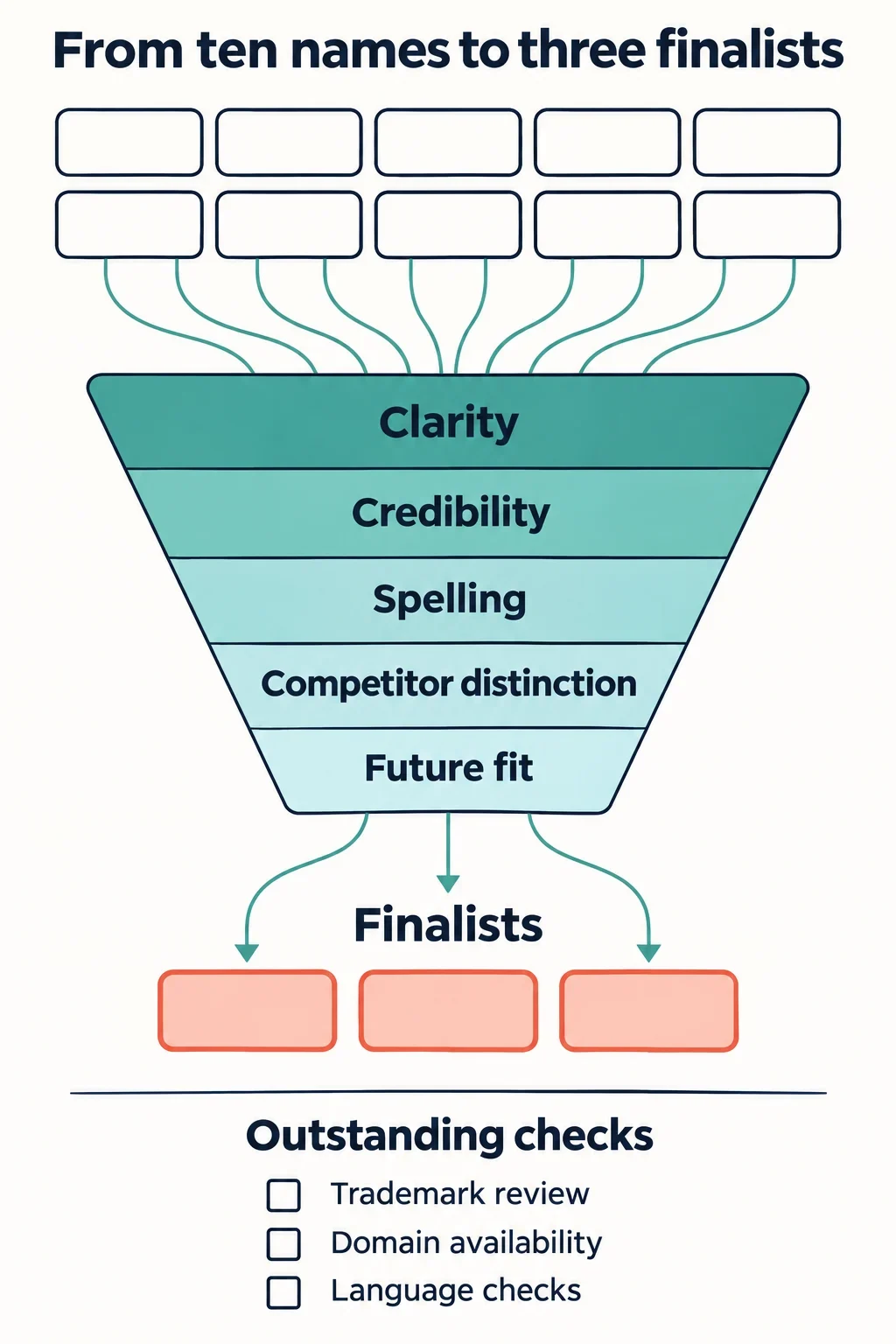
To shortlist generated names for a local cleaning service, begin with what customers need to understand: the cleaning you offer, who you serve and where you work. Review a small batch of suggestions, then test the strongest names for service clarity, credibility, spelling over the phone and distinction from nearby businesses. Consider future service areas before committing to a place reference.
Treat the result as a working shortlist. A name that sounds suitable still needs the relevant business-name, trademark, domain and account checks. The workflow below helps you retain two or three candidates with a clear reason for each choice and a written record of what remains unresolved.
Define what the cleaning business name should communicate
Write a short brief before evaluating suggestions. This gives you a consistent basis for choosing between an appealing name and one that actually fits the business.
Record four things:
- Services: the cleaning work you intend to offer, including any important limits.
- Customers: the households, businesses or other clients you want to reach.
- Service area: where you plan to work initially and where expansion is realistic.
- Desired impression: the qualities you want potential customers to associate with the business.
Keep the desired impression specific enough to test. If you choose “professional,” ask what a customer would need to hear in the name to form that impression.
A descriptive name can communicate a category or function directly. For your shortlist, ask whether customers should recognize the cleaning service from the name alone or whether the name would need a clear accompanying description. Neither approach should excuse a misleading impression.
Finish the brief with this sentence: “Customers should understand that we provide [services] for [customers] in [area], with an impression of [qualities].” Use it throughout the screening process.
Generate a manageable batch using documented controls
Start with one keyword drawn from the service or desired impression, and review ten suggestions at a time. For example, “cleaning” expresses the offer, while “care” could serve as a prompt for the impression you want to explore. These are possible starting inputs, not recommended business names.
Follow the documented controls of the generator you choose. If it accepts a keyword, enter your selected word. If it offers additional settings, read what each setting does before using it. Record the input, any settings you actually used and the candidate names returned. If the output contains more than ten suggestions, select a manageable batch for review.
Change one available condition at a time. You might replace the keyword while keeping other settings unchanged, or adjust one documented setting while retaining the keyword. This makes the effect of each change easier to assess.
Read every candidate in a practical sentence: “[Candidate] provides [service] for [customers] in [area].” Keep names that deserve testing, and note why you rejected the others. Generate another batch when you can identify what the first one lacked.
Screen for service clarity and credibility
Show each candidate to potential clients without first explaining the intended meaning. Ask, “What would you expect a business with this name to do?” Compare their answers with your brief. A name needs further scrutiny if listeners consistently expect a service you do not offer.
Then ask which candidates they would trust most for their cleaning needs, and why. Record their reasons alongside their preferences. “I understand what they offer” gives you a more useful decision point than “I like that one.” If someone dislikes a name, ask what creates that reaction before discarding it.
Separate three judgments:
- Does the name communicate the intended service?
- Does it create a credible impression for the intended customers?
- Does it suggest a promise the business can actually support?
Review words that imply a particular result, qualification or service scope. If you cannot support the expectation they create, remove the candidate or revise it. A reassuring sound is not enough when the underlying message is inaccurate.
Run a spelling test over the phone
Say each surviving candidate aloud and ask someone to write it down without seeing the spelling. A phone conversation provides a useful setting for this exercise. Use your normal speaking voice, and avoid spelling out unusual parts before the listener attempts the name.
Record the first answer before offering help. Note the exact spelling written down, any request for repetition and any explanation you needed to give. If you repeat the test with another person, use someone who has not already seen the candidate.
A simple record can contain:
- The intended spelling.
- The listener’s first attempt.
- Any sound or word boundary they found ambiguous.
- The clarification needed to reach the intended spelling.
Assess the pattern rather than setting an arbitrary pass mark. A single mistake may need another test; repeated confusion deserves closer attention. Keep this result separate from personal preference: someone can like a name and still struggle to spell it after hearing it.
Compare candidates with nearby cleaning businesses
Build a comparison list of cleaning businesses you find serving the intended area. Record the names as displayed, where you found them and the date of your review. Compare each finalist with those names for similar wording, sound and appearance.
Ask practical questions: could someone repeat your candidate aloud and have it mistaken for another local cleaner? Would the two names be easy to distinguish in a list of search results? Does a small spelling change leave the overall impression unusually close?
Use a table to keep observations specific:
| Candidate | Nearby business compared | Observed similarity | Follow-up |
|---|---|---|---|
| Your candidate | Name found during research | Shared wording, sound or appearance | Revise, investigate or retain with a reason |
Distinction from industry competitors is a useful naming criterion. However, keep potential customer confusion and trademark questions in separate notes. This comparison helps identify concerns for further investigation; it does not establish that a candidate is legally clear. Record what you searched so the limits of the review remain visible.
Decide whether a geographic reference will still fit
Compare place-based candidates with alternatives that do not name a location. Use both your initial service area and realistic expansion plans. Avoid choosing around an imagined expansion that has no bearing on how you expect to operate.
For each geographic reference, ask whether a customer outside that place could reasonably question whether you serve them. Also consider whether you would still want to use the name if work expanded into neighbouring areas.
| Naming approach | Question for the current business | Question for future plans |
|---|---|---|
| Town or neighbourhood reference | Does this accurately describe our intended area? | Would the reference still fit additional locations? |
| Broader geographic reference | Is the area implied appropriate to our plans? | Would realistic expansion remain within that description? |
| No geographic reference | Is the service clear enough without a place name? | Would the wording still fit the business we expect to run? |
Do not automatically reject a local reference. Keep it when the connection is intentional, and write down the circumstances that would make you reconsider it.
Identify local naming requirements and potential trademark conflicts
Establish the jurisdiction and intended business structure before deciding which naming requirements apply. Write down where the business will be based, where it expects to operate and whether the proposed customer-facing name will also be its official legal name.
The official legal name and a trading name used to market products or services can be different. Ask the relevant authority which requirements apply to your proposed arrangement, including any applicable trading-name requirements. Use its current instructions to identify the searches and filings you need.
Keep registry and trademark searches separate
For a US business, include a search of the relevant state’s business registry for an existing entity using the same name. Record the registry searched, the query, the date and the result. For another jurisdiction, identify the appropriate registry and its instructions before searching.
Conduct a separate trademark investigation. For a US business, include the USPTO trademark database. Search the candidate itself and investigate relevant similarly spelled or similar-sounding names. Keep notes on potentially conflicting results rather than treating an exact-name search as the whole exercise.
A registry result does not settle every trademark question. Likewise, an initial search is preliminary. Where a result raises uncertainty, record the specific issue and seek an appropriate assessment before committing to the name. Your shortlist should show which checks are complete, which are pending and which findings still need interpretation.
Check domains and intended account handles separately
Write down the exact domain and account handles you would want for each finalist. Check each one separately through the relevant domain or account service, and record the result with the date. Avoid summarizing several different checks as “available online.”
Use separate rows for the preferred domain, any domain alternative you would genuinely consider and each intended social account. Record the exact spelling checked. If the preferred version is unavailable, assess any alternative against the same clarity and spelling criteria you used for the business name.
Ask whether you would be comfortable saying the proposed web address aloud. If an alternative introduces extra words or an unfamiliar spelling, test that version before accepting it.
Keep these findings separate from business-name and trademark checks. An available domain or handle does not resolve the other questions, and a preferred business name does not establish online availability. Recheck the intended versions when you are ready to act, retaining the date of the latest check.
Choose finalists with a written rationale
Compare the surviving candidates against criteria weighted to match your brief. Agree the priorities before assigning scores so that an early favourite does not quietly reshape the assessment.
The following is an example weighting to adapt:
| Criterion | Example weight | Basis for assessment |
|---|---|---|
| Service clarity | 25% | What potential clients expected the business to offer |
| Credibility | 25% | Trust preferences and the reasons given |
| Spelling over the phone | 20% | Written attempts and clarification needed |
| Distinction from nearby competitors | 20% | Recorded wording, sound and appearance comparisons |
| Fit with future service areas | 10% | Comparison with realistic expansion plans |
Use a consistent scoring scale, with a brief explanation for every score. Keep unresolved naming or trademark concerns outside the preference score: a strong total does not answer an outstanding legal question.
Retain two or three options, identifying a preferred candidate and alternatives. For each, write a short rationale covering why it fits the brief, its strongest test results, its main weakness and any outstanding checks. Give each pending check a clear next action.
Your final decision record should make the choice understandable to someone who did not attend the discussions. It should also identify what could change your preference, such as a repeated spelling problem or an unresolved conflict. This gives you a usable shortlist and a concrete path toward a final choice.