On this page
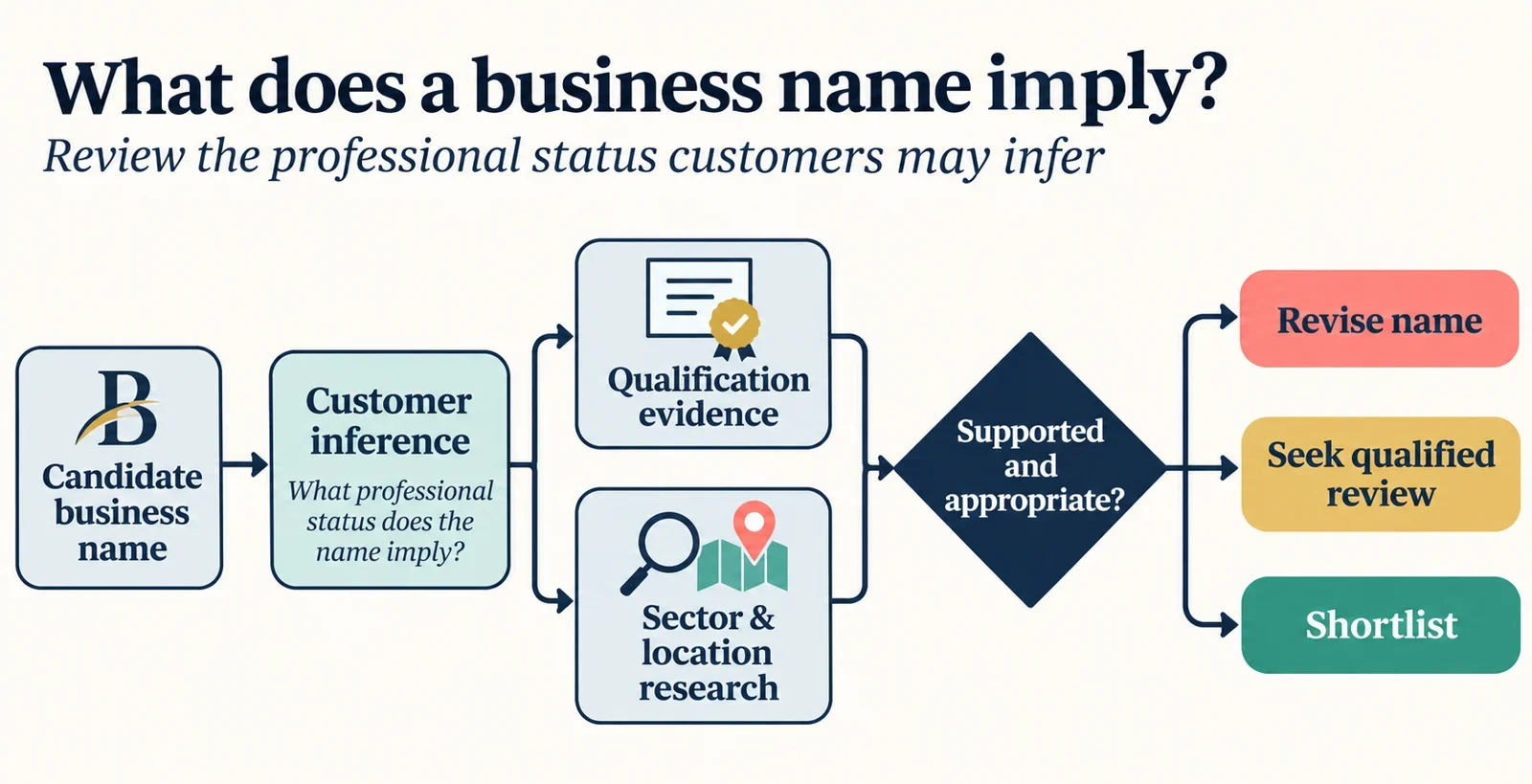
Screen each generated business name by asking what professional status a customer might infer, then compare that impression with qualifications you can document. Research the relevant sector and location before deciding whether a candidate belongs on your shortlist. Keep this assessment separate from checks of company names, trademarks and domains.
Use the workflow below to turn a list of suggestions into a reviewable set of decisions. For each name, record the wording that raises a question, the evidence supporting it and anything still requiring confirmation. A name should remain pending while a material qualification question is unresolved.
Start with the business's services, qualifications and locations
Write a short factual brief before generating names. Include the services you intend to offer, the customers you want to reach and the places where the name will be used. Products or services, intended audience and place of use provide relevant context for evaluating a name.
List the qualifications actually held, who holds each one and which planned services you believe it supports. Keep the underlying documents available for later comparison. Record intended operating locations and customer locations separately so you can investigate which ones matter to the proposed activity.
Describe practical boundaries as well as ambitions. If only one member of the team holds a credential, record that explicitly. If a service is planned but its qualification requirements remain unchecked, mark it as pending. This brief becomes your reference point: assess the name against the business you can currently describe and substantiate.
Generate candidates using confirmed controls
First inspect the chosen generator and note the inputs and options it actually displays. If it offers a keyword field, enter a plain description of the main service from your brief. Where optional controls are available, adjust only those you understand, and record the settings used.
Review the output in the form provided. Copy the candidate names into a separate working list, preserving their exact spelling and any significant punctuation. If you want another batch, change one input at a time so you can compare the suggestions usefully.
Keep generation and qualification review as separate steps. Treat every suggestion as a candidate requiring assessment. Before relying on any claimed screening feature, establish what it checks, which locations it covers and what its results mean. Leave those questions open unless you can confirm the answers.
Highlight wording that could imply professional status
Read each candidate once as a prospective customer, then again as an editor. Highlight wording such as licensed, certified, accredited, chartered, doctor and engineer. Treat these examples as prompts for research into the relevant sector and location; assign no automatic legal conclusion to the word alone.
Also flag unexplained abbreviations and combinations of ordinary words that seem to suggest professional standing. Ask what the whole phrase promises: a qualification held by an individual, a credential covering the business, approval of a particular service, or an official relationship?
Write the possible inference beside the highlighted phrase in everyday language. For example: ‘A customer might expect everyone delivering this service to hold the credential.’ Use that sentence as a review hypothesis and test it against the documents. If several interpretations seem plausible, record each material one rather than choosing whichever is easiest to support.
Match each implied qualification to supporting evidence
Build an evidence record for every candidate that raises a qualification question. Link each implied claim to a specific document or confirmation, rather than attaching a general folder of credentials and assuming it covers everything.
| Check | What to record |
|---|---|
| Holder | The person, business or other entity named in the evidence |
| Services | The activities the document expressly covers |
| Location | Any stated geographical scope |
| Validity | Dates, current status and any conditions requiring confirmation |
| Match | Whether that evidence supports the candidate’s likely impression |
Read the document closely and mark anything you cannot establish. A credential held by one practitioner should prompt a separate question about the business wording: does the proposed name suggest a broader qualification than this evidence supports?
For a candidate containing ‘certified,’ identify exactly who or what is being presented that way. If the evidence and the implied claim concern different holders or services, keep the candidate pending while you investigate or revise it.
Check the applicable sector and location requirements
Use the service and location brief to identify the authority able to answer each unresolved question. Look for an official body relevant to the profession, activity or proposed wording, and confirm that its remit covers the location you are researching.
Separate the questions you ask:
- What permission or registration, if any, is required to provide the intended service?
- What conditions, if any, apply to using this exact name, title or abbreviation?
- Does the proposed wording require a particular qualification, accreditation, approval or relationship, and who must hold it?
Provide the exact candidate, intended services, relevant locations and credential details when seeking an answer. Ask whether the answer applies to the individual practitioner, the business or both.
Record the authority, the date checked, the relevant guidance and any unresolved interpretation. Where responsibility is unclear, ask which body can confirm the point. Keep uncertain candidates for qualified review before treating the wording as suitable.
Assess the impression created by the complete presentation
Place each candidate beside the service description, introductory paragraph and proposed web address. Read the combination as a customer would encounter it. Ask what qualification, approval or affiliation the presentation appears to claim, including anything suggested indirectly.
Try two practical checks. First, ask someone unfamiliar with the business to describe the expertise they would expect. Use their answer to identify questions for review, without treating one person’s reaction as conclusive. Second, compare that expected expertise with the evidence record and highlight any broader impression.
If you add an explanation, read the complete presentation again. Does the clarification address the concern plainly, or does the name still leave the original impression? Do not assume a qualification elsewhere in the text resolves the issue. If the concern persists, revise the candidate or hold it for advice. Repeat this review whenever you materially change the surrounding description.
Keep qualification checks separate from availability searches
Keep a separate result for each type of check. Record the question asked, the search scope, the date and the outcome, so you can see what still needs attention.
| Check | Record separately |
|---|---|
| Generator | Candidate wording and confirmed generation settings |
| Company register | Register searched, exact query and returned result |
| Trademark search | Search scope, terms used and findings requiring assessment |
| Domain check | Exact address checked and the reported availability result |
| Professional status | Implied qualification, supporting evidence and applicable requirements |
Use the professional-status record to decide whether the claimed expertise is supported. An encouraging availability result should not substitute for that assessment or be recorded as permission to use professional wording.
Distinguish ‘checked, with no relevant findings’ from ‘not checked’ and ‘unable to check.’ These describe different evidence outcomes. If a register was inaccessible or a search scope was unclear, preserve that limitation in the record. Schedule the missing check rather than silently converting uncertainty into a clear result.
Resolve uncertain candidates before shortlisting
Bring the work together in a decision record containing the candidate name, implied status, supporting evidence, applicable location, unresolved issue and next action. Add a person responsible for resolving each issue so promising candidates do not drift onto the shortlist without review.
Assign a practical outcome to each name:
- Shortlist: the identified qualification questions have been resolved for the intended services and locations.
- Revise: replace wording that creates an unsupported implication, then repeat the relevant checks.
- Hold: obtain clarification or qualified review before deciding.
- Discard: remove a candidate whose problematic implication you cannot satisfactorily resolve.
For a revised name, preserve the previous decision and explain what changed. A small wording change deserves another reading in context, especially if the service description or web address also changes.
Before moving forward, read every shortlisted name against the original brief once more. Confirm that the evidence record supports the intended presentation and that no unresolved qualification question has been mistaken for approval.