On this page
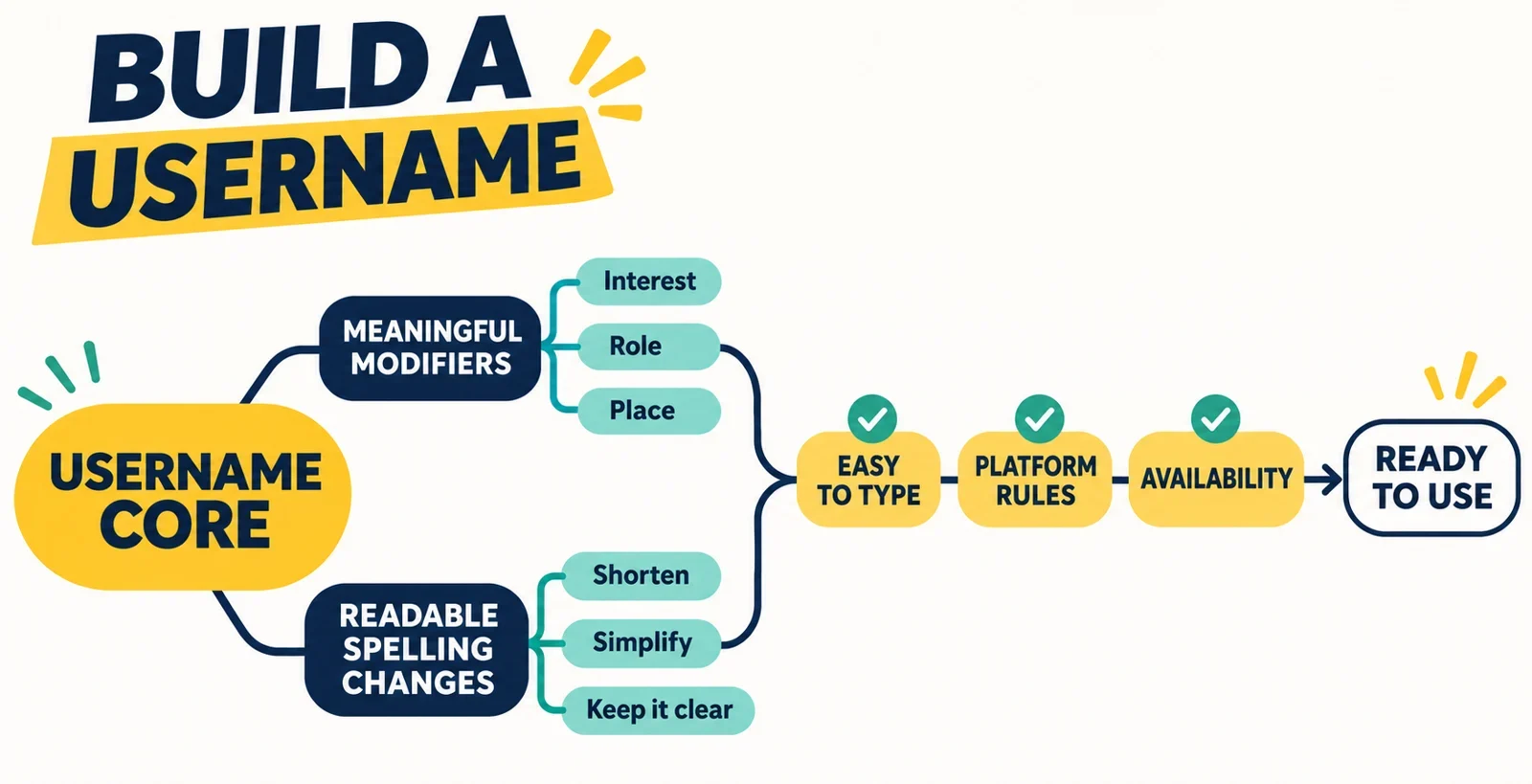
When your preferred username is taken, keep its most recognizable word or sound and change one surrounding element at a time. Start with a meaningful modifier or complementary word, then consider modest spelling or separator changes. Shortlist the versions you can comfortably say and type, and check each exact spelling through the intended platform’s username-selection process.
Generated suggestions are starting points. A promising combination still needs your judgment about meaning, readability and suitability for the platforms you plan to use. The workflow below follows an invented example, mosslantern, to show how those decisions fit together. Every example is a candidate for comparison; none is presented as available or accepted by a particular service.
Choose the recognizable core to keep
Begin by identifying what you would miss if you replaced the original handle entirely. It might be a particular word, the sound of the full combination, or the image it brings to mind. Write that preference down before generating more options so you have a clear reason to accept or reject each variation.
For the illustrative handle mosslantern, you could decide that lantern is essential, that the whole phrase should remain intact, or that you mainly want the pairing of a natural image with a familiar object. Those choices lead to different edits. Keeping the full phrase favors additions such as mosslanternsketch; keeping only one word leaves more room for new combinations.
Set a simple editing boundary
Use a sentence such as: “Keep mosslantern unchanged, and add one word connected to drawing.” This gives the next round a purpose. You can revise the boundary later, but avoid changing the core, adding a modifier and altering the spelling all in the same first attempt.
Ask yourself which part someone should still recognize after the change. If your answer is the entire original phrase, protect its spelling while you explore additions. If your answer is a theme, allow more variation but compare each candidate against that theme. You do not need to preserve every character to preserve the idea; decide deliberately what continuity means for you.
Generate a focused batch around a non-sensitive keyword
Choose a non-sensitive interest or image to guide the next batch. Drawing, clouds or lanterns could provide a direction without requiring personal identifiers. Prefer something you are comfortable associating with the account, and leave out details you would rather keep private.
Use the keyword to explore a specific question: would an activity word improve the handle, or would another image create a more appealing combination? Keeping that question narrow makes the output easier to compare. You can then select suggestions because they serve your intended identity, rather than simply because they look unusual.
If the generator offers length controls, consult its documented settings and choose a range that leaves room for the core and a useful addition. Do not assume its settings match the requirements of your intended platform; check those separately before settling on a candidate.
If no candidates appear
Try widening the length range where that control is available, or simplify the keyword. Change one condition, then compare the next results. For example, a single image word gives you a simpler starting point than a phrase containing several interests.
Save only a few candidates that meet your editing boundary. Record what you like about each: the core remains intact, the added word fits your activity, or the combination is easy to say. These notes will help you choose between appealing alternatives without repeatedly restarting the search.
Add a meaningful modifier or complementary word
When the base handle is occupied, try adding a word that has a clear connection to your interests or intended identity. An activity, subject or image can give the variation a reason to exist. Choose something you would be comfortable explaining when someone asks why you picked the name.
Test the addition both before and after the recognizable core. Read each version as a complete name rather than judging the words separately. With the illustrative drawing-related modifier sketch, compare sketchmosslantern and mosslanternsketch. Both retain the original phrase, but you may prefer how one sounds or where it places the emphasis.
| Illustrative candidate | What it preserves | What to consider |
|---|---|---|
mosslanternsketch |
The full core at the beginning | Whether the added length feels comfortable to type |
sketchmosslantern |
The full core after a modifier | Whether you like saying the activity word first |
mosslanterncloud |
The full core plus another image | Whether the combined image feels coherent to you |
These examples have not been checked for platform acceptance or availability.
Compare the candidates against your actual purpose. If the account will cover several interests, consider whether a narrowly focused activity word still suits it. If you mainly want to preserve an existing identity, favor an addition that leaves the familiar phrase easy to spot. Keep the strongest combination and a distinct alternative for later checks.
Compare readable spelling and separator changes
If a meaningful addition does not produce a candidate you like, compare modest spelling and separator changes. Adding or removing separators is one adaptation pattern, but use a particular character only after checking that the intended platform permits it.
For comparison, write the core as mosslantern, moss.lantern and moss_lantern. Judge the versions visually, then say each one aloud as though someone else needed to enter it. Decide whether you are comfortable explaining the punctuation whenever you share the handle verbally. Permission to use a separator and your willingness to dictate it are separate decisions.
Shortening is another option to evaluate carefully. Remove a portion you have already decided is flexible, then check whether the result still carries the word, sound or image you wanted to preserve. If the shortened version needs a long explanation, return to the fuller form and compare a different addition.
Test substitutions explicitly
Possible substitutions include zero for the letter o and one for the letter l. Before keeping an example such as m0sslantern, ask someone to read it back, or describe it aloud yourself: would you need to specify “zero” to get the intended spelling?
Do not assume a substitution improves the candidate merely because it creates a different string. Compare the effort required to read, dictate and type it. Start with one change, evaluate the result, and add another only if it solves a problem you can clearly identify.
Check the platform's username requirements
Before choosing a modified spelling, consult the intended platform’s own username requirements. Find the field it identifies as the unique username and distinguish that choice from the display name. A display name you like does not establish whether the corresponding username can be selected.
Check the current instructions for the exact candidate you want to use. Avoid carrying assumptions from one service to another, especially when your variation depends on punctuation or a particular length.
Useful questions to resolve include:
- Does the candidate fit the platform’s stated username length requirements?
- Are all of its letters, numbers and separators permitted?
- Does the username-selection process accept the exact spelling you entered?
- Are you evaluating the unique username field rather than a display-name field?
If a candidate fails a requirement, return to the smallest flexible part of your plan. For example, if your chosen separator is not permitted, compare joining the words before replacing the recognizable core. If the candidate exceeds the stated length, reconsider the modifier or an intentional shortening.
Keep platform compliance and personal preference as separate checks. You may love a spelling that the platform will not accept, or find that an accepted spelling is awkward to share. Retain a candidate only after it satisfies both your practical needs and the requirements of the service where you intend to use it.
Test typing, pronunciation and consistency
Read each shortlisted handle aloud, then type it without copying. These are useful checks before you commit to a fallback. Say the full spelling you would give another person, including any separator or number that needs explanation, and compare the typed result with your saved candidate.
If practical, ask someone to type the handle after hearing it once. Treat the result as feedback about that candidate. Notice where they pause, which part you repeat, and whether the modifier is remembered. Then decide whether a different word order or simpler spelling would better suit the way you expect to share the account.
Choose which platforms matter most
List the platforms you expect to use and mark the ones that matter enough to influence your decision. Try the same meaningful modifier across those priority channels where possible. Evaluate the exact full handle on each service rather than assuming that a successful check on one settles the others.
Use a compact comparison note for each candidate:
- Can I say it comfortably?
- Can I type it accurately without copying?
- Does it preserve the core I chose?
- Can I use the same spelling on my priority platforms?
If different spellings are necessary, record them explicitly and consider whether you are comfortable remembering and sharing those differences. You may prefer a slightly longer candidate that works consistently across your chosen platforms. Let that be a deliberate tradeoff, supported by your checks, rather than an accidental collection of variations.
Confirm availability and retain a backup
Check your strongest candidates directly through the intended platform’s account-creation or username-selection process. Enter each exact spelling, including punctuation and numbers. A generated suggestion remains a candidate until you have completed the relevant platform check; do not treat its appearance in a list as confirmation of availability.
Record the platform, exact candidate and result. Use plain notes such as “accepted during username selection,” “rejected,” or “not checked.” If the process gives you a reason for rejection, record that wording so you can address the stated problem without guessing.
Keep the distinction between checking and selecting clear in your own notes. If you only tested a name, record that. If you completed the selection, record the spelling that was actually saved. Before sharing the new handle, review the account’s username field to catch any difference between your intended candidate and the final choice.
Keep one usable alternative ready
Retain a backup that has passed the same readability and platform-requirement checks as your first choice. Give it a clear order of preference, so an unsuccessful availability check does not send you back to an unfiltered list of suggestions.
Your decision should answer four questions: does the handle preserve the identity you wanted, can you comfortably say and type it, does it meet the intended platform’s requirements, and what did the direct availability check show? Once those answers support a candidate, save its exact spelling alongside your backup and use that record when setting up your priority accounts.