On this page
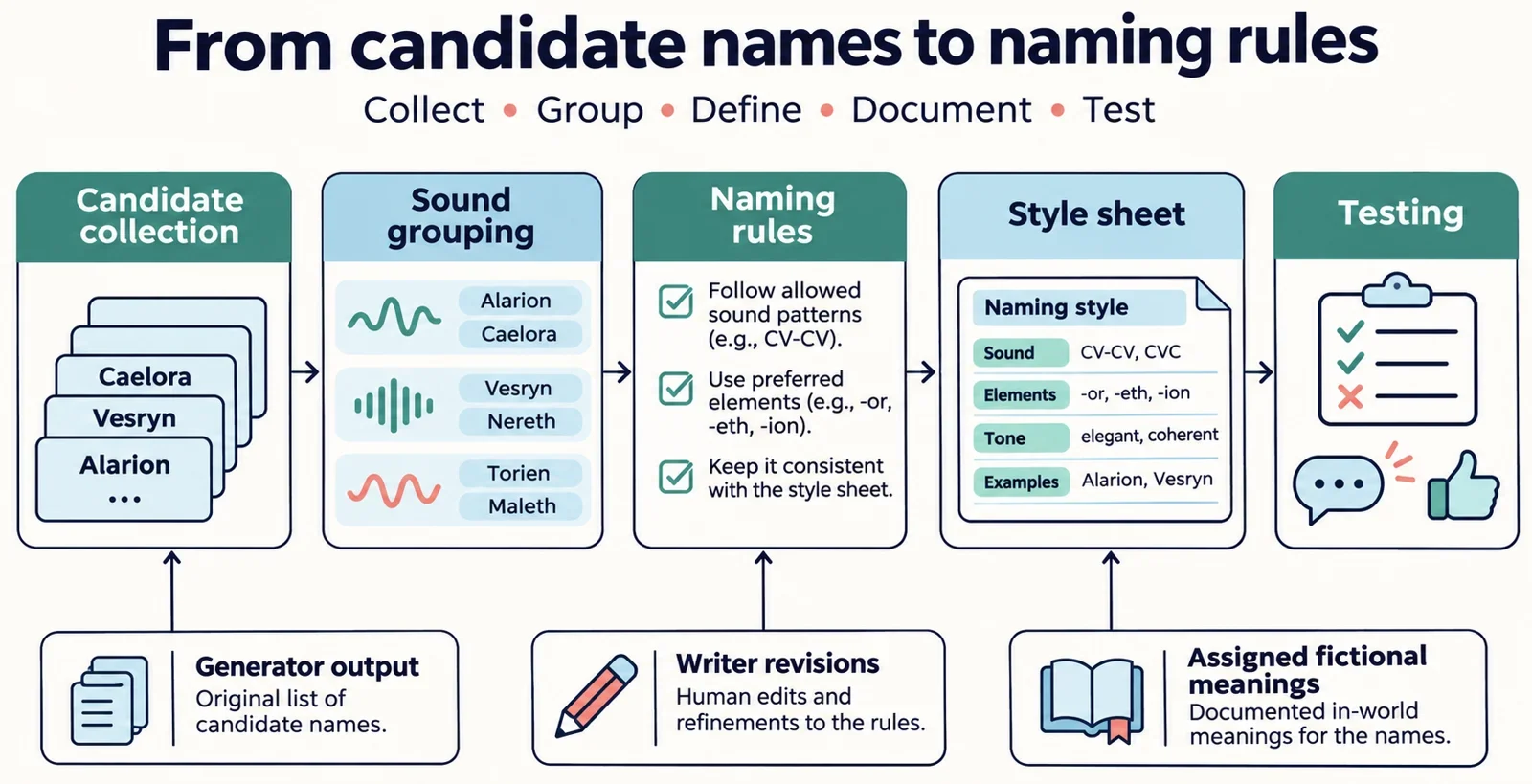
To build a reusable fantasy naming system, collect a small batch of candidates, compare their recurring sounds and decide which patterns deserve rules. Record those decisions, then use them to name someone new. You can create enough consistency for a household, village or region without developing a language for conversation.
Keep three things distinct throughout the process: the generator’s original output, your revisions and the meanings you assign within the fictional world. That separation lets you change a spelling or develop a family connection without losing track of where the name began. The worked examples below use invented practice names and fictional conventions to show how each decision fits into a compact style sheet.
Define the naming task and collect a starting batch
Begin with a group small enough to compare directly: one household, several neighboring families or the characters in an opening scene. Write a brief describing who needs names and what connections readers should notice. For example: “Two related households from neighboring districts, with recognizable family names and distinct everyday names.”
Match your brief to the available inputs
Use the input fields and choices actually displayed by your chosen generator. Record their labels and the values you enter or select. If an option addresses something in your brief, note that connection. Handle any remaining preferences through your own selection and editing process.
Collecting six to ten candidates is a practical starting target. Compare the results against the same brief before changing settings, so you can identify what you want to keep.
Maintain separate records for each layer:
| Layer | What to record |
|---|---|
| Original output | The exact result, any accompanying gloss and the settings used |
| Writer revision | Your changed spelling, shortened form or recombination |
| Fictional meaning | The meaning or social significance you deliberately assign |
For the running exercise, use these invented practice candidates: Selara, Selora, Venara, Venor, Kelara and Kelor. These examples demonstrate editorial choices; they are not a recorded generator run. When working with actual results, preserve each original beside its later revisions.
Group candidates into provisional sound families
Compare initial letters, opening sounds, vowel patterns, syllable counts and repeated endings. At this stage, a group only means that you have noticed a resemblance. You can decide later whether that resemblance belongs to a family, region or broader naming tradition.
The practice list supports several overlapping groups:
- Selara and Selora: similar openings and closely related spellings.
- Venara and Venor: a repeated opening with different endings.
- Selara, Venara and Kelara: a shared -ara ending.
- Venor and Kelor: another possible ending pattern to investigate.
Choose a pronunciation before relying on syllable counts or sound comparisons. Written resemblance alone does not settle how you intend a name to be spoken.
Check consistency and confusion separately
Ask two questions: “Does this name belong with the others?” and “Could a reader mistake it for another character’s name?” A pattern can help with the first question while causing trouble with the second.
Selara and Selora might work as related place labels that rarely appear together. As the everyday names of two frequent scene partners, they may deserve a revision. Keep useful patterns in the system while varying the names that readers must distinguish quickly.
Turn recurring pieces into roots and construction rules
A recurring piece becomes a meaningful root when you deliberately give it a stable role. Repetition gives you something to consider; it does not require you to assign a meaning.
For this fictional exercise, make three choices:
| Element | Assigned fictional meaning | Allowed position |
|---|---|---|
| sel | quiet | First |
| ven | bright | First |
| ara | river | Second |
Now define the construction rule: the first element describes the second. Under this rule, Selara receives the assigned meaning “quiet river,” and Venara receives “bright river.” These are creative glosses established for the story, not verified translations from an existing language.
Record how elements join. Here, the rule is to join them directly, capitalize the completed name and add no connecting letters. Permit these combinations for household surnames within the chosen setting. Leave kel, -ora and -or without assigned meanings until you have a reason to develop them.
Decide what the rule excludes
Because ara occupies the second position, reversing the elements does not produce an approved name under this rule. If a combination sounds awkward or resembles another important name too closely, reject that candidate or revise the rule explicitly.
Keep recurring elements and their meanings consistent. A surname gloss also needs a stated role: “quiet river” can be an inherited name without describing every person who bears it.
Create regional variations from a shared base
Choose one controlled difference first, then test whether the shared structure remains recognizable. For this example, invent a river district and an upland district. Both use the same roots and descriptive order, but newly established household names use different forms of the final element.
| Shared base | River-district form | Upland-district form | Assigned meaning |
|---|---|---|---|
| sel + ara | Selara | Selare | quiet river |
| ven + ara | Venara | Venare | bright river |
Record are as the upland form of ara, with the same assigned meaning. Specify that this change applies at the end of these household names; it does not authorize replacing every occurrence of the letter a.
Choose pronunciation cues as well. For this exercise, Selara is seh-LAH-rah, while Selare is seh-LAH-reh. These cues express the writer’s intended readings.
Define the social boundary of the rule: new households adopt the local form when their surname is established, while existing households retain their recorded surnames after moving. That makes regional variation usable without forcing every relocation to create a spelling change.
Test the relationship by placing the forms side by side. If you want stronger regional differences later, add each change separately and document its scope.
Define family connections and everyday name forms
Choose which feature carries the family connection. Relatives might share a surname, a recurring root or another explicitly defined element. Start with one convention that serves the story.
In this exercise, use given name + inherited household surname. Mira Selara and Neri Selara belong to the same household. Their given names remain individually chosen; the surname construction rule does not govern every part of their names. Record that boundary so future characters do not accidentally acquire extra requirements.
Decide what a place label means
A place label could identify current residence, birthplace or family association. Select its meaning and answer the movement question directly.
For this example, an optional label such as “of the river district” identifies current residence and changes after a move. The inherited surname remains unchanged. This lets a character’s address change while preserving the household connection.
Record who uses each form
A character entry might read:
| Form | Use within the fiction |
|---|---|
| Mira Selara | Formal introductions and household records |
| Mira | Ordinary conversation among acquaintances |
| Mi | A nickname used by Neri |
| Mira of the river district | A residence label when location matters |
Add aliases only when the story needs them, and identify who knows or uses each one. If a longer name is intended to mark a ceremony or office, write that convention down; length alone need not establish social rank.
Document deliberate exceptions
An exception works best when it has a specific bearer, a clear departure from the normal rule and a fictional reason to remain. An older name, an adopted identity or cross-regional upbringing can support such a decision when it serves the story.
Suppose you retain Selora as an older settlement name. The current naming pattern would suggest Selara, but the settlement keeps Selora because its inhabitants preserve that earlier form. Record the decision explicitly:
- Canonical form: Selora.
- Departure: It does not use the current -ara ending.
- Fictional reason: The settlement deliberately retains its older name.
- Meaning: Unassigned; do not automatically transfer the newer construction’s gloss.
- Scope: This settlement name only.
That record prevents a future editing pass from treating the spelling as an error. It also prevents one retained form from silently authorizing -ora throughout the system.
Before accepting another exception, ask what it contributes. If the unusual name matters to a character’s identity or a place’s history, document it. If it only compensates for an unclear rule, clarify the rule first.
Assemble a reusable naming style sheet
Bring the decisions together in a reference you can use while drafting. Include accepted examples alongside the rules so you can see what an approved result looks like.
Copyable system template
- Scope: Which people, places and name components follow this system?
- Sound patterns: Which openings, vowel patterns, lengths and endings are preferred?
- Pronunciation: What readings have you chosen for approved names?
- Roots and glosses: Which elements have assigned meanings, and which remain unassigned?
- Construction: What element order, joining method and spelling conventions apply?
- Regional variants: What changes, where does it apply and who follows it?
- Family conventions: What do relatives share, and how is that connection maintained?
- Place labels: Do they express residence, origin or family association? Do they change after a move?
- Everyday forms: Which formal names, nicknames and aliases exist, and who uses them?
- Exceptions: What is retained, which rule does it depart from and why?
- Accepted examples: Which completed names demonstrate the current rules?
- Revision history: Which earlier spellings should remain searchable?
Compact record for an approved name
Canonical name: Mira Selara. Pronunciation: MEE-rah seh-LAH-rah. Breakdown: Mira is an individually chosen given name; Selara is sel + ara. Assigned meaning: The surname has the fictional gloss “quiet river”; Mira has no assigned gloss. Bearer: Mira, a member of the Selara household. Everyday forms: Mira; Mi when addressed by Neri. Origin record: Invented tutorial example.
For your own entries, replace that origin record with the exact generator result and settings, or identify the name as your own invention. Preserve any intervening revisions separately.
Test the sheet on new characters and shared scenes
Test whether the sheet can answer a new naming task without requiring an undocumented decision. Begin with a relative, then introduce someone from outside the immediate household.
Name a new relative
Add Tovin Selara to Mira’s household. The shared surname follows the family convention, while the given name remains individually chosen. Record TOH-vin as its intended pronunciation and leave its meaning unassigned. If you find yourself adding a required given-name ending, decide whether the story needs that additional rule before adopting it.
Name a newcomer
Introduce Daven Venare, from an established upland household. Venare follows the regional form of ven + ara and retains the assigned surname gloss “bright river.” If Daven moves to the river district, the surname stays Venare under the existing rule; a current-residence label changes.
Read the likely scene companions together
Try a short exchange containing Mira Selara, Tovin Selara and Daven Venare. Read the names aloud and inspect them on the page. Check whether nicknames create new collisions and whether a scene containing both Selara and the settlement Selora remains clear.
When something fails, revise the smallest relevant decision: one everyday form, one candidate or one rule. Keep earlier spellings as lookup entries pointing to the canonical form. Finish by asking: Can I name another relative and another newcomer using only this sheet? If the answer requires an extra rule, record that decision and test it again.