On this page
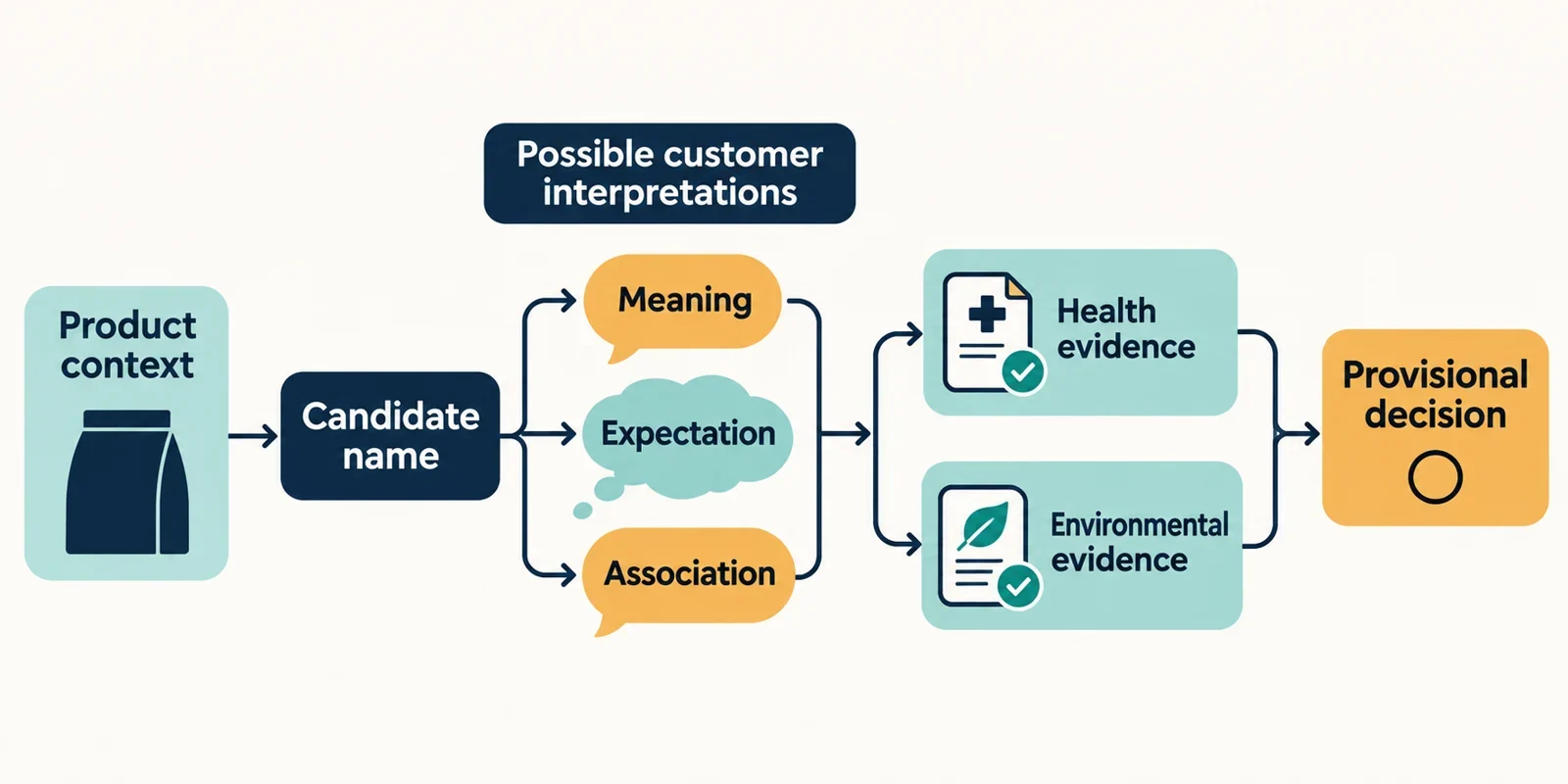
Check a generated brand name by writing down what a customer might reasonably expect from it, then comparing that expectation with evidence for the actual product or business. Keep a candidate only provisionally when the likely promise fits the support; revise, pause or discard it when that relationship remains unresolved.
Start with a small shortlist and assess every name against the same product, audience and market. Treat your interpretations as questions to investigate, rather than established customer findings. The aim is a name whose central message you can explain honestly without relying on a disclaimer to reverse it.
Define the product and intended customers
Begin with a short brief: what you will sell, where you plan to operate and who will encounter the name. If one name will cover several products, include each intended use instead of assessing only the easiest example.
Add a compact evidence inventory:
- Product characteristics you can document.
- The specific item, component or activity each document concerns.
- Conditions, limitations and comparisons relevant to that information.
- Planned products or markets that still need separate review.
Separate what is already supported from what you hope to offer later. An ambition should not become the assumed basis for evaluating a name.
For example, if you are considering a footwear brand, describe the actual footwear and intended customers before considering whether a health-related name fits. Use this same brief for every candidate so that an appealing name does not quietly change your assessment criteria.
Generate and record a small shortlist
The documented Nameward brand-name starter inputs are language, style, keyword, count, length and seed. Verify which controls the generator you actually use provides; these inputs do not establish what another website offers.
Choose a shortlist small enough that you can review each entry carefully. For every saved candidate, record:
- Language and style requested.
- Keyword entered.
- Requested number of suggestions.
- Length setting.
- Seed value, if provided.
- Exact output and any later edits.
Record the language and style you requested, and preserve the keyword as entered. Keep count, length and seed with the session record rather than guessing their effect from a finished name. Check the tool’s explanations before relying on an unfamiliar setting.
Save the wording itself alongside the settings. A suggestion is a starting point for review, not evidence that its implications are supported. Assess your favourite by the same criteria as the others.
Translate each name into a possible customer promise
For each candidate, complete this sentence: “A customer seeing this name on this product might expect…” Write a concrete expectation that you could investigate, rather than an impression such as “sounds positive.”
The following are invented practice names, not reported generator results or customer findings:
- HealStep: On footwear, a shopper might interpret this as suggesting help with recovery or a particular health problem. Investigate which outcome, if any, people actually infer.
- PlanetKind: A shopper might interpret this as suggesting environmental benefits across the product or business. Investigate how broadly they understand that promise.
Write down plausible alternative readings too. Someone might understand a name as a general theme, while another person reads it as a specific benefit. Neither interpretation becomes established merely because your team proposed it.
If you seek customer feedback, begin with an open question such as “What would you expect from this product?” Record their words before introducing your own concerns, so you can distinguish spontaneous expectations from prompted answers.
Investigate health implications separately
Give each possible health interpretation its own review. Ask whether the name suggests an outcome, a safety assurance or suitability for a particular group. Avoid combining these into one broad question about whether the product is “healthy.”
For a hypothetical HealStep candidate, write down the exact interpretation under consideration. “Might help recovery from a particular problem” requires a different investigation from “seems intended for everyday walking.” Do not assume evidence addressing one statement also answers the other.
For each interpretation, ask:
- Does the evidence concern the product you intend to sell?
- Does it address the expected outcome and intended users?
- What conditions or limitations affect its relevance?
- What product-category and market questions need qualified review?
If you cannot answer these questions, pause the candidate or explore wording that avoids the unresolved promise. Obtain advice suited to the product and intended market before relying on a health interpretation. Treat that advice as part of the review, not as permission to generalise beyond its scope.
Match environmental implications to the scope of evidence
Greenwashing describes false or misleading environmental claims. To review an environmental name, compare the breadth of its possible message with the breadth of the information supporting it.
Use a scope table to keep the comparison explicit:
| Evidence concerns | Question to investigate |
|---|---|
| One component | Does the name imply something about the whole product? |
| Packaging | Could customers understand the promise as covering the contents? |
| A particular process | Does the name suggest benefits beyond that activity? |
| Part of the business | Could the message be read as covering every operation? |
For a hypothetical PlanetKind candidate, suppose your only supporting information concerns a packaging change. Record that limited scope; do not treat it as proof of broad environmental performance.
Check any comparison behind the information. Compared with what, for which characteristic, and under which conditions? Ask whether the same basis applies to the product you plan to sell.
If the name appears broader than the support, revise the wording or investigate further. A narrow improvement should remain narrow in the explanation and in your naming decision.
Review the name with its surrounding message
Place each candidate beside the product description, colours, imagery and logos you intend to use. Review the combined message, then compare it with your earlier assessment of the name alone.
Ask whether another element introduces or strengthens a promise. For example, would a hypothetical PlanetKind presentation alongside environmental imagery encourage a broader interpretation? Would health-focused wording make a hypothetical HealStep name seem more specific? These remain questions to investigate, not assumed customer reactions.
Draft a plain explanation of what you can support. Then ask whether it genuinely clarifies the name or has to contradict its central message. If the name appears to promise a whole-product benefit while the explanation concerns packaging alone, address that mismatch directly.
When gathering feedback, show the intended presentation as well as the isolated name. Record which version people saw, because you are evaluating two different messages.
Choose whether to retain, revise, pause or discard
Create one decision record per candidate. Include its wording, possible customer promise, relevant evidence, scope mismatch, unresolved questions and intended presentation. Keep your interpretation separate from any customer feedback you have collected.
Use four provisional outcomes:
| Decision | When to use it |
|---|---|
| Retain | The interpretations assessed fit the available support, with limitations recorded. |
| Revise | A wording or presentation change could address the identified mismatch. |
| Pause | A material question requires further evidence or qualified review. |
| Discard | The central promise exceeds the support and you do not intend to pursue it. |
For every revision or pause, record a concrete next action: change a word, examine evidence for a stated outcome, or review the intended market. Assign responsibility if several people are involved.
Retaining a candidate means it can proceed to further consideration. It does not resolve every question about using the name. Revisit the decision if the product, audience, market or surrounding message changes.
Regenerate and reassess revised candidates
Use the review findings to guide another naming session. If a keyword repeatedly produces suggestions with an unresolved health or environmental promise, try a different keyword or style where those controls are available.
Change one input at a time when practical, and record the new settings beside the resulting shortlist. This makes your own comparisons easier without assuming that any setting guarantees a particular result.
Repeat the full review for each revised candidate: possible interpretation, relevant evidence, scope, surrounding message and provisional decision. A less assertive name still needs assessment; a neutral first impression does not establish suitability.
Keep domain and trademark availability checks as separate decisions. An available domain does not answer whether a name’s implied promise is supported. Carry forward candidates with a clear decision record and specific next steps, so the next review begins with what you have learned.