In this guide
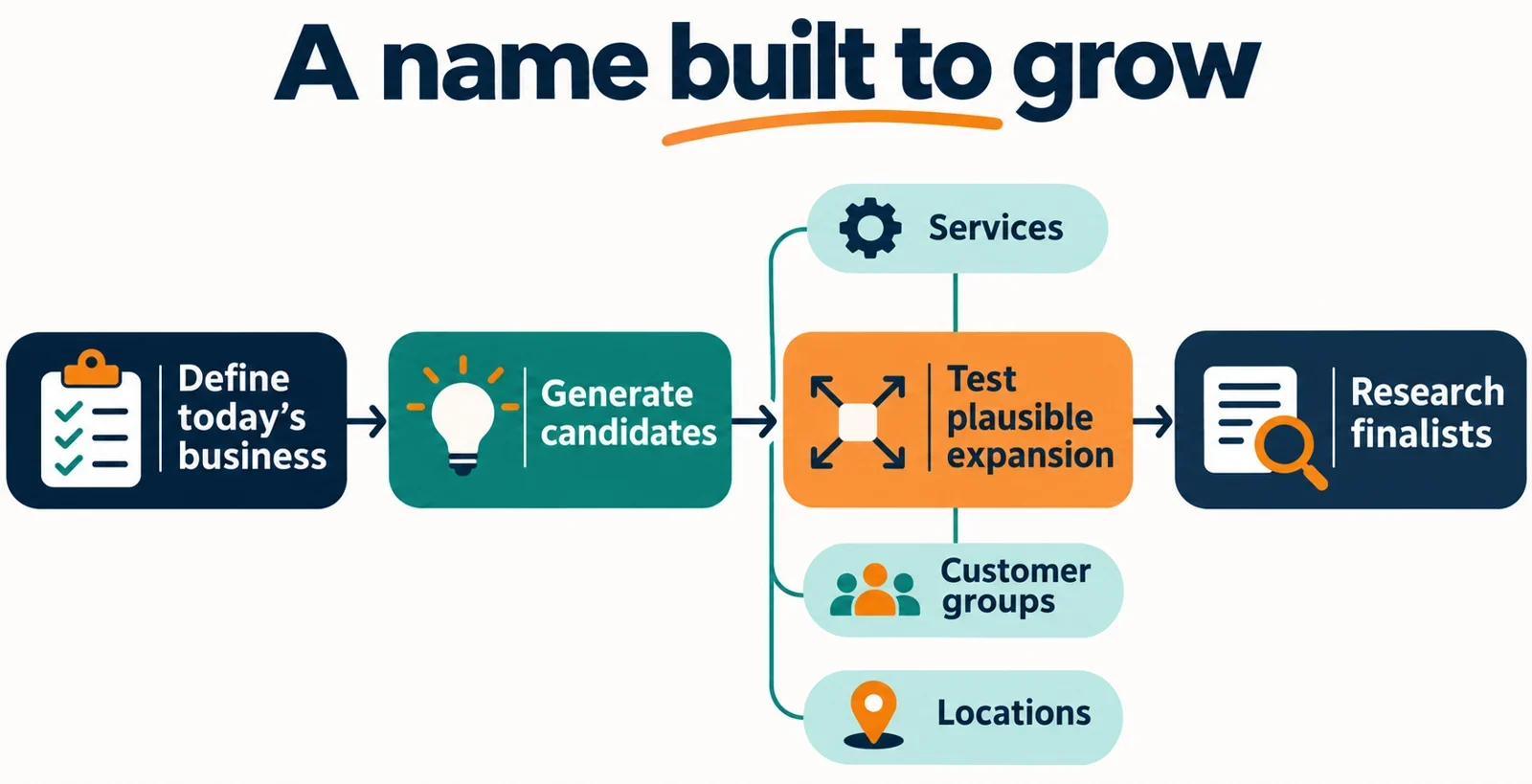
Choose a generated business name by testing two things together: whether it helps customers understand your current offer and whether it still makes sense after a realistic expansion. A name does not need to describe everything you might eventually do. It should communicate something useful today without tying your identity to a detail you already expect to change.
Start with a short business brief, generate candidates from a focused word, and compare each candidate against the same three scenarios: an adjacent service, a different customer group and another location. Read the strongest names aloud in an ordinary business introduction. Then research registration, trademarks, domains and handles separately before committing. This turns a list of appealing suggestions into a decision you can explain.
Define the business today and its plausible next steps
Before generating names, write down what a customer should understand after hearing your name once. Focus on the current offer, intended customers and operating area. Add the feature of your approach that you most want the name to suggest, provided it reflects how you intend to run the business.
A useful brief can fit into a small worksheet:
| Part of the brief | What to write |
|---|---|
| Current offer | The main product or service customers can buy now |
| Current customers | The people or organizations you intend to serve |
| Operating area | Where you intend to do business initially |
| Desired impression | One quality you want customers to associate with the business |
| Next service | One related addition you could realistically pursue |
| Next customer group | One additional audience you might serve |
| Next location | One additional area you might enter |
For a hypothetical shoe-repair shop, the expansion scenarios might be bag repairs, work for business customers and operating in another town. Keep those scenarios specific enough to test, without treating them as commitments.
Avoid testing every imaginable future. If a possibility would require an entirely different business, set it aside for this exercise. The brief should help you judge plausible growth while keeping the present offer central.
Generate a comparison batch from a focused keyword
Choose one starting word from your offer or the impression you want to leave. In the hypothetical repair business, a word such as “repair” emphasizes the activity, while “care” explores a desired impression. These are possible starting inputs, not endorsements of particular names.
Use the inputs and controls shown in your chosen generator. Record the starting word and any other settings you actually use so you can compare the next batch fairly. Keep a short list of candidates worth reading closely, rather than trying to evaluate every suggestion at once.
Treat each result as a naming candidate. Decide whether its wording belongs on your shortlist before making assumptions about whether you can register it, protect it or use matching online accounts.
For a useful second batch, change one condition. You might replace “shoe” with “repair” while leaving the other inputs unchanged. If you change several things together, you have a less direct comparison when deciding which adjustment helped.
Keep the original batch beside the revised one. Write a concrete observation, such as “the second batch accommodates bag repairs more naturally,” instead of relying only on whether the results feel more appealing.
Spot words that create unnecessary limits
Underline words that tie a candidate to a particular product, audience, area or way of delivering the service. Then ask what each word contributes. A narrow word may explain the business clearly; the question is whether that benefit remains useful under your actual expansion plans.
| Wording to examine | Question to ask |
|---|---|
| A single product | Would this still describe the business after adding the adjacent service? |
| A customer group | Would another intended audience think the offer includes them? |
| A neighborhood or town | How would you introduce the business in the additional location? |
| A delivery method | Would the wording still fit if customers could buy or receive the service another way? |
Do not reject a candidate simply because it contains a specific word. If your planned growth stays within that word’s scope, the specificity may remain helpful. Likewise, do not assume that removing every specific word produces a better name.
Mark each restriction as useful, uncertain or mismatched with a planned step. Beside an uncertain word, record the exact reader question it raises. For example: “Would a customer seeking bag repairs understand that this shop could help?” That gives you something concrete to test during shortlist review.
Put every candidate through the same expansion test
Write a present-day introduction for every candidate, then add the same expansion statements. Keep the wording around the name as consistent as possible so you are comparing the candidates against a shared standard.
Use these sentence frames:
- “We are [name], and we currently provide [offer] for [customers] in [area].”
- “We now also offer [adjacent service].”
- “We also serve [additional customer group].”
- “We now operate in [additional location].”
Read the introduction and each announcement together. Note the exact word that creates a problem, rather than recording only “doesn’t fit.” Does the name suggest a narrower offer than the announcement? Does the new customer group require an extra explanation? Does a location word become awkward when you describe the additional area?
Then test the combined future: the same business offering both services, serving both customer groups and operating in both areas. A candidate that survives each change separately still deserves a reading with the whole proposed business in view.
Distinguish a problem in the name from a problem in your sentence. Rewrite an unclear introduction once, then repeat the test. If the explanation still needs to work around the same word, record that as a reason to revise or reject the candidate.
Keep enough meaning when broadening a name
Consider two hypothetical names for the repair-shop example: “Northside Shoe Repair” and “Cedar Care.” They illustrate a naming tradeoff; neither is presented as an available name.
“Northside Shoe Repair” explicitly identifies shoe repair and includes a location cue. When testing bag repairs and another town, examine whether those words would require repeated explanation. “Cedar Care” leaves more of the activity and operating area unstated, so test whether customers can understand its purpose with a clear explanatory line.
| Test | Northside Shoe Repair | Cedar Care |
|---|---|---|
| Present offer | Explicitly names shoe repair | Needs more explanation of the offer |
| Adding bag repairs | Test whether “Shoe” feels too restrictive | Test alongside a line naming both services |
| Serving business customers | Check the full introduction for audience fit | Check whether the offer is sufficiently specific |
| Operating in another town | Examine the effect of “Northside” | Introduce the additional location and assess clarity |
For “Cedar Care,” a present-day explanatory line could be “Shoe repair for individual and business customers,” if that accurately describes the intended offer. After adding bag repairs, a revised line could name both services.
Evaluate the name and explanatory line together wherever you expect to use them together. Also read the name alone. Ask what a listener understands before seeing the extra wording.
The goal is enough room for plausible growth while retaining a useful identity. If the broader candidate needs a long explanation every time, try a middle option that keeps an enduring part of the offer in the name.
Read and compare the shortlist
Put the remaining candidates into one worksheet. Use the same questions for every name and support each judgment with a short observation.
| Criterion | What to record |
|---|---|
| Present-day clarity | What the name and introduction communicate about the current offer |
| Future services | The result of the adjacent-service announcement |
| Customer groups | Any wording that needs explanation for the additional audience |
| Locations | Any mismatch in the additional operating area |
| Pronunciation | Where a listener hesitates or asks for clarification |
| Spelling | What someone writes after hearing the name |
| Decision | Keep, revise or reject, with a specific reason |
Read each candidate in a normal introduction rather than announcing it as an isolated word. Ask a listener to repeat it, write it down and explain what they think the business offers. Record their response before supplying your intended interpretation.
If pronunciation or spelling causes difficulty, identify the troublesome part. A preference for unusual wording is a separate consideration from whether you are comfortable explaining it in everyday introductions.
Choose a concrete decision for each candidate. “Keep: clear repair purpose and fits all three expansion statements” is useful. “Revise: the product word excludes the planned bag service” points to the next action. You do not need a numerical score if written reasons make the tradeoffs clear.
Revise the input when a candidate fails
Use the worksheet to choose the next generation decision. Start with the weakness you want to address, then change one relevant input while retaining the same business brief and expansion scenarios.
| Observed weakness | Next adjustment to consider |
|---|---|
| Names keep emphasizing one product | Replace the product keyword with an activity shared by the planned services |
| Names say little about the offer | Try a word closer to the business’s actual purpose |
| Location wording conflicts with expansion | Reconsider whether the starting input needs the current area |
| Names are awkward to introduce | Revisit the input wording and compare candidates for spoken use |
| Candidates feel interchangeable | Return to what the business does differently and choose a more purposeful starting word |
If your generator provides a relevant style or length control, you can test that control as a separate change. Use only options actually available in the tool you have chosen. Keep the other inputs steady during that comparison.
Run the revised candidates through the original worksheet. Avoid relaxing a requirement simply because a new name is attractive. If your business ambitions have genuinely changed, update the brief and reassess every finalist against it. Otherwise, keep the criteria stable so the revision answers the problem you identified.
Research the finalists before committing
Once a candidate fits the present business and plausible expansion, identify the jurisdiction and business structure you intend to use. Use those details to guide research into the applicable naming requirements. Record the name you intend to register and any separate trading name you intend to use in marketing, then investigate how the relevant rules apply to each.
Keep distinct research notes for each finalist:
- Registration: Check the relevant registration authority’s current naming requirements and search process for your intended jurisdiction and structure.
- Trademarks: Research the proposed name in relation to the products, services and markets you intend to pursue, including the expansion scenarios.
- Domains: Check the exact domain options you would consider using and record the results separately.
- Handles: Check the exact account names on the platforms you plan to use.
Treat a favorable result in one area as a reason to continue the remaining checks. Do not use a domain search as a substitute for registration or trademark research. If the meaning of a result is unclear, get appropriate advice before committing.
Finish with two separate decisions: whether the name suits the business, and whether the relevant research supports using it. Keep a backup finalist that has passed the same expansion tests. If research rules out your first choice, return to a candidate you have already evaluated rather than selecting an untested replacement under pressure.